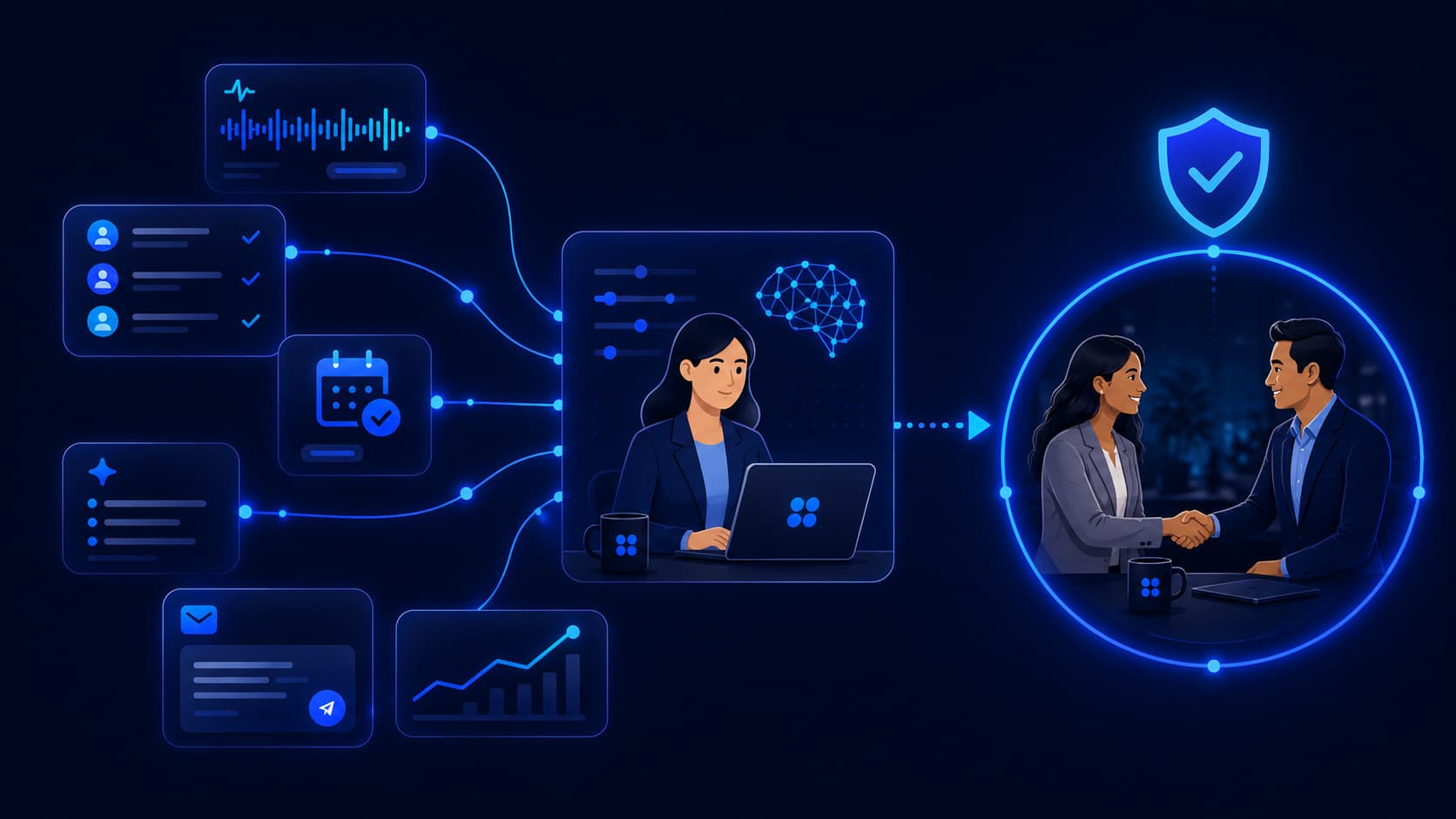

The math problem haunting every sales leader is brutally simple: your SDRs spend roughly two hours per day actually selling. The rest? Listening to rings, hitting voicemails, navigating phone trees, updating CRMs, and staring at screens waiting for someone - anyone - to pick up.
According to Cognism Calling Statistics - salespeople spend about one-third of their day actually talking to prospects. Gartner's research makes this even more painful: it takes 18 or more dials to connect with a prospect over the phone, with callback rates hovering below 1%.
That's not a productivity problem. That's a physics problem - and parallel dialing is how you break the physics.
What Parallel Dialing Actually Does (and Doesn't Do)
Parallel dialing eliminates the dead time between calls by dialing multiple numbers simultaneously. When someone picks up, you're instantly connected. When they don't - which happens roughly 80% of the time according to ZoomInfo; the system moves on without you hearing a single ring.
The difference in raw throughput is significant. Traditional manual dialing gets you maybe 35-40 dials per hour if you're disciplined. A power dialer (one number at a time, automated sequencing) bumps that to 40-60 dials per hour. Parallel dialing? Depending on the configuration - typically 2 to 10 lines running simultaneously; you're looking at 100-600+ dials per hour (depending on your list’s connect rate).
But here's what the vendors don't always emphasize: more dials only matters if those dials turn into conversations. Parallel dialing at 10x doesn't help if your connect rates stay at 5%. What matters is talk time - the minutes spent actually having conversations with prospects. That's where the real productivity gains emerge.
The Latency Problem Nobody Talks About
Legacy call platforms weren't built for this use case. Many bolted on parallel dialing as an afterthought, which creates a specific technical problem: detection latency.
When someone answers a parallel-dialed call, the system needs to determine almost instantly whether it's a human, a voicemail greeting, or an IVR phone tree. If that detection takes even 2-3 seconds too long, you've already lost the prospect ("Hello? Hello? Anyone there?"). If it's too aggressive, you're having reps talk to voicemail..
Legacy dialers - including many of the conversation intelligence tools that have added dialing features - rely on keyword-based detection that struggles with natural speech patterns. A voicemail that starts with "Hey, this is Mike" sounds a lot like a human pickup to a system matching audio patterns from a decade-old model.
This is where TwinsAI stands out. We built our detection engine from scratch for this exact problem. Our custom model separates human pickups from voicemail systems and IVRs with far greater accuracy than retrofitted dialer tools. Reps end up in more real conversations and waste far less time listening to recordings.
And now that both iPhone and Android are rolling out advanced call screeners, TwinsAI is already prepared with its Screener Detector Connector feature. Our voice agents understand when a device is screening a call and respond with the right personalized message so the call moves forward instead of getting filtered out. This keeps your connect rate strong even as carriers tighten the funnel.
The Real Economics: A Case Study in Velocity
Consider a fictional but representative example. CloudMetrics (a mid-market SaaS company) had a team of four SDRs doing outbound calling into their dormant lead database - contacts who had engaged with content or attended webinars but never converted. Their numbers before implementing parallel dialing looked like this:
- 50 -80 manual dials per rep per day
- 5% connect rate (industry average according to Firmable)
- 2-3 live conversations per rep daily
- 8-10 meetings booked across the team monthly through phone outbound
The math was clear: with a typical 2.3% cold calling success rate (per Cognism's 2025 State of Cold Calling Report), they needed dramatically more conversations to move the needle on pipeline. Hiring two more SDRs would cost $164K+ annually in cash compensation alone, plus tools, management overhead, and ramp time.
Instead, they implemented parallel dialing at 5 lines per rep with AI-powered human detection. The results after 90 days:
- 250 dials per rep per day
- Same 5% connect rate, but across 3.6x more attempts
- 9 live conversations per rep daily (up from 2-3)
- 28 meetings booked monthly (up from 8-10)
Pipeline increased by over 200%. Cost per meeting dropped by roughly 65%. And critically - no additional headcount, no additional management complexity, no 90-day ramp period for new hires.
Where Parallel Dialing Makes Sense (And Where It Doesn't)
Parallel dialing isn't universally applicable. It excels in specific scenarios:
High-volume outbound on lower-quality lists. If you're working aged leads, event attendees, or contacts with unknown qualification status, parallel dialing lets you efficiently separate the responsive from the unreachable. Dialing 2-5 lines at once on lists where you expect single-digit connect rates makes mathematical sense.
Re-engagement campaigns. Dormant leads sitting in your CRM represent sunk cost. Parallel dialing is the most capital-efficient way to determine which of those leads might still have a pulse.
Speed-to-lead on inbound. When demo requests or high-intent signals come in, parallel dialing multiple contacts at an account simultaneously can dramatically reduce time-to-connect - a metric where research consistently shows first responder advantage.
Lower ACV, higher velocity sales motions. If your average deal is under $25K and you're playing a volume game, maximizing conversations per rep per day is the right optimization.
Parallel dialing makes less sense when you're outbound team is prospecting into highly researched, account-based outreach to a small list of strategic targets. Dialing 5 numbers at once at your top 50 enterprise prospects is probably not the vibe you're going for.
The sweet spot for parallel lines typically falls between 3-6 for most use cases. Going higher (up to 10) works well for very low-quality lists where you're essentially doing qualification by availability. Going lower (2-3) makes sense when list quality is decent and you want to maintain some preparation time between connects.
The Pricing Reality Check
Here's where the conversation gets uncomfortable for a lot of buyers.
Enterprise conversation intelligence platforms have migrated aggressively into the dialing space. Gong, for example, has expanded well beyond call recording into engagement and forecasting modules. The bundled pricing for their full platform now runs approximately $250 per user per month; and that's before the platform fees that can add $5,000 to $50,000 annually plus $15-$65k implementation depending on organization size. Multi-year contracts are standard. And on top of that they all have minimum seat requirements.
For a 50-person sales team, you're looking at first-year costs that can approach $200K when you factor in platform fees, implementation, and professional services. And here's the thing: many teams report using maybe 30-40% of the capabilities they're paying for.
TwinsAI took a different approach. The platform includes parallel dialing, AI-powered human detection, personalized voicemail drops, conversation intelligence, and CRM integration at a fraction of the enterprise pricing. No $50K platform fees. No forced multi-year commitments. No paying the same per-seat rate for a CS rep who needs basic transcription as an AE who needs the full feature set.
The value play isn't about being a stripped-down alternative. It's about building modern AI first infrastructure from scratch - without the legacy architecture overhead; and passing those economics on to customers. Teams get comparable (and in some cases superior) functionality, particularly on the parallel dialing and detection side, at 60-70% lower total cost.
Making the Transition
If you're currently running manual dialing or a basic power dialer, the shift to parallel dialing requires some operational adjustment.
Start with list segmentation. Not every list deserves the same dial intensity. Build separate calling queues for high-intent inbound (lower parallel, faster response), engaged leads (medium parallel), and cold/dormant lists (higher parallel).
Train for faster talk tracks. When connects come faster, reps need to be mentally ready faster. The dead time between calls that used to allow for "okay, who am I calling next?" preparation disappears. Your opening needs to be tight, immediate, and confident.
Monitor the right metrics. Stop fixating on dials. Start tracking conversations per hour, talk time per session, and connect-to-meeting rates. These are the metrics that actually correlate with pipeline.
Use voicemail strategically. With parallel dialing, you'll hit more voicemails than ever. Use personalized voicemail drops that are tight (under 30 seconds), create curiosity, and reference a follow-up touchpoint. The voicemail becomes part of the multi-touch sequence, not wasted time.
The Bottom Line
The fundamental equation in sales development hasn't changed: more conversations equals more pipeline. What's changed is that technology now allows you to compress the time required to achieve those conversations dramatically.
Parallel dialing at 5 lines doesn't make your reps 5x better at selling. It makes them 5x more likely to be in a conversation where they can sell.
The legacy platforms that dominated the conversation intelligence space were built in a different era, with different assumptions about cost structure and technical approach. They work - but they work expensively, and they work on architecture that wasn't designed for the velocity demands of modern outbound.
If your SDR team is currently maxing out at 50-60 manual dials per day and wondering why the pipeline is stuck, the math isn't complicated. You don't have a problem with people. You have a physics problem. Parallel dialing is how you solve it; and you don't need to spend enterprise money to get enterprise results.
Ready to multiply your team’s talk time with Parallel Dialing? Sign up for a free 7 day trial and we’ll walk you through how to implement it without adding headcount.