
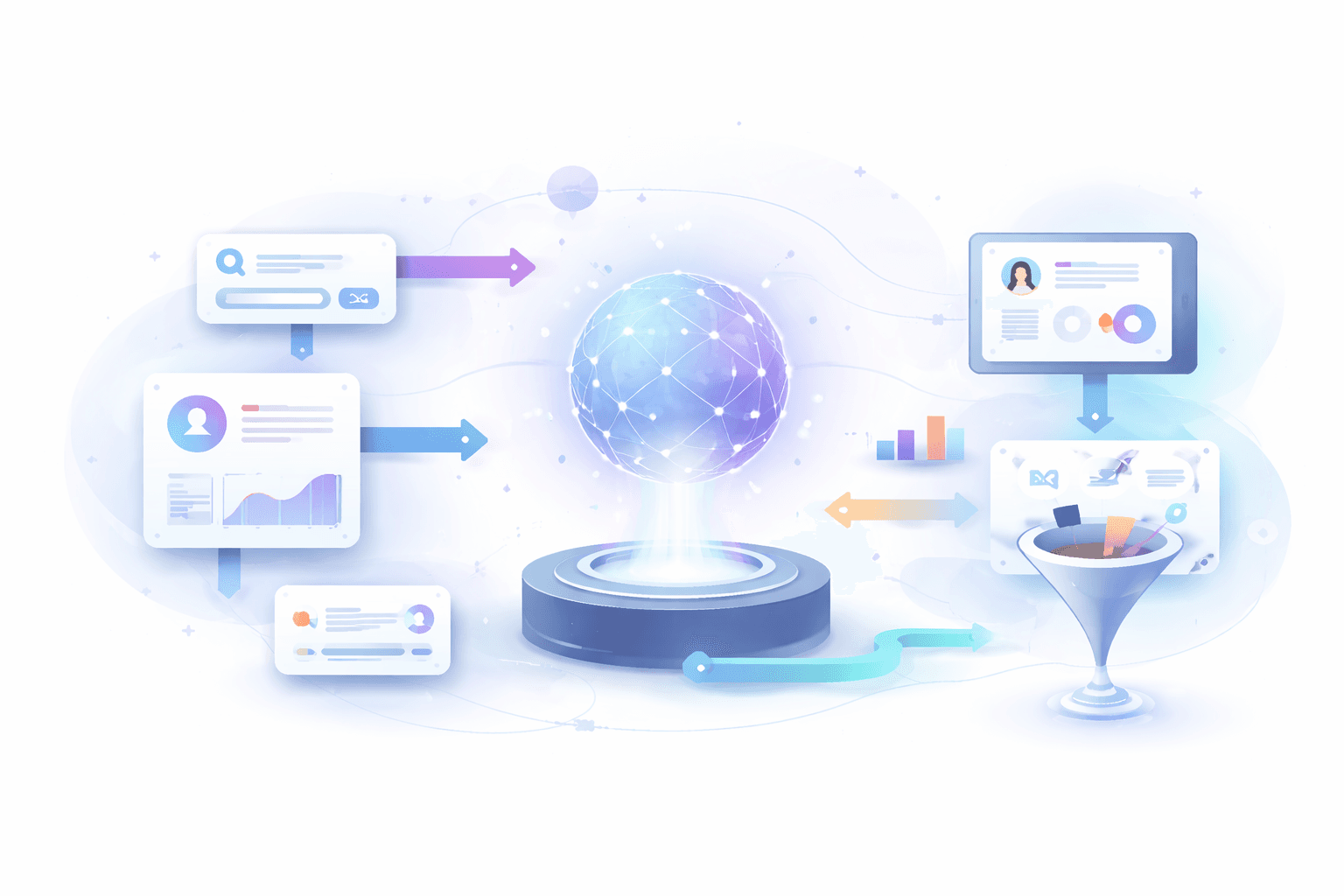
The old outbound playbook is finished. Spray-and-pray died somewhere between the tenth ignored sequence email and the rise of buyer-side research tools. Everyone knows this now.
Most teams took signals and plugged them into the same workflow infrastructure they've always used. Track job changes, monitor pricing page visits, reach out when there's intent—new trigger, same playbook. Funding announcement fires sequence A. Champion changes jobs, fires sequence B. Intent score crosses threshold, fires sequence C.
The tools are connected. The data is flowing. And conversion rates barely moved.
A workflow routes. It doesn't think.
Your best rep looks at an account and weighs a dozen factors before deciding what to do. The champion's new role. The timing of their contract renewal. What they browsed last week. Whether a call makes sense or an email is smarter. Whether to lead with cost savings or implementation speed.
That's judgment. And no amount of workflow automation replicates it. You've built a faster system for executing decisions, but the decisions themselves are still either manual or missing entirely.
This is the ceiling most GTM teams are hitting right now. They've adopted signals. They've modernized the stack. They're still stuck.
Signals + Agents: The Framework
The architecture that's emerging separates two distinct problems:
Signals tell you WHEN to act and WHO to prioritize. They're the trigger layer. Account signals reveal fit and context. Trigger signals (funding, new hires, product launches) indicate change. Contact signals surface individual readiness.
The real leverage comes when you connect them. It's not just that someone visited your pricing page. It's that they visited pricing after reading a competitor comparison blog post, while their company is hiring three SDRs, and they're six months into a contract with your competitor. That's context.
Agents extend HOW your best reps think. They're the reasoning layer. Systems that synthesize context, weigh alternatives, and apply the same decision patterns your top performers use—but across hundreds of accounts simultaneously.
Signals without agents speed up your workflows. But you're still executing templates, just with better timing.
Agents without signals puts AI in place, but doesn't tell it when to wake up. You're reasoning over stale data with no sense of urgency.
We're not fully there yet. But the architecture is becoming clear.
The Three-Layer Agent Framework
The framework that works mirrors how your best reps think. Three layers:
Layer 1: Context — What does the agent know?
The connected understanding of everything happening with an account. CRM history, website behavior, social signals, intent data, hiring activity, personnel moves, company news. All accessible in a single view.
Most teams have the data. Almost nobody has it connected in a way an agent can reason over.
Layer 2: Reasoning — How does the agent decide?
This is where you scale judgment. You encode your best reps' instincts in plain language:
- Prospect went dark after demo? Check if they just got re-orged.
- Multiple stakeholders hitting docs? Loop in your champion now.
- Competitor's customer browsing your site? Lead with migration, not features.
- Contract renewal in 60 days? Stop nurturing, start closing.
The reasoning layer applies the same thinking your best rep would use. The difference: it does this across hundreds of accounts, continuously, without fatigue.
Layer 3: Action — What can the agent do?
The execution layer. Email composition. Call scheduling. LinkedIn congrats. CRM updates. Meeting booking. Each agent gets only the tools it needs. Constraints create focus.
The key insight: Humans don't operate the agents. They build the context graph, encode the strategic thinking, and configure the actions. Then agents scale that thinking. Humans observe, learn, and tune.
Dormant Leads: The Framework in Practice
We're building toward this vision in pieces, not all at once. One example: reviving dormant leads.
Most companies have thousands of contacts sitting in their CRM who showed interest months ago and went dark. Our approach uses the framework: pull context from HubSpot (what they downloaded, pages visited, previous engagement), apply reasoning (is this lead worth a call? what should we say?), then execute via AI voice with full situational awareness.
The result is thousands of personalized conversations that would have taken a human team months to complete. It's not the full agentic GTM stack yet, but it's a working piece of it. We wrote up the full implementation here.
Why Voice Matters
The email-automation crowd won't say this: when timing is right, voice wins.
An email is easy to ignore. A well-timed call with genuine context is a conversation. Prospect doesn't pick up? Personalized voicemails provide access to a separate inbox, increasing response rates for all other channels.
When your signals indicate high intent, the highest-leverage action isn't another email in a crowded inbox. It's a call that demonstrates you actually understand their situation.
This is why we built Smart Calling into TwinsAI. Signal detection triggers the agent. The agent reasons over context and decides if a call is the right move. If it is, the call happens with full context loaded. Not a script. Genuine situational awareness.
The Window Is Now
Right now, almost nobody in GTM has their context graph built, agents reasoning over signals in production, or judgment encoded instead of templates.
In six months, this architecture will be table stakes. The teams building toward it now will have compounding advantages.
This isn't about doing more outreach. It's about reaching out only when it makes sense and showing up with context that earns the next meeting.
Signals tell you when. Agents scale how your best reps think. The combination is what comes after workflows.
Want to see signal-based agentic outreach in practice? [Learn more about Smart Calling from TwinsAI.]